
Now Reading: Schoonschip: Amsterdam’s Floating Neighborhood of the Future
-
01
Schoonschip: Amsterdam’s Floating Neighborhood of the Future

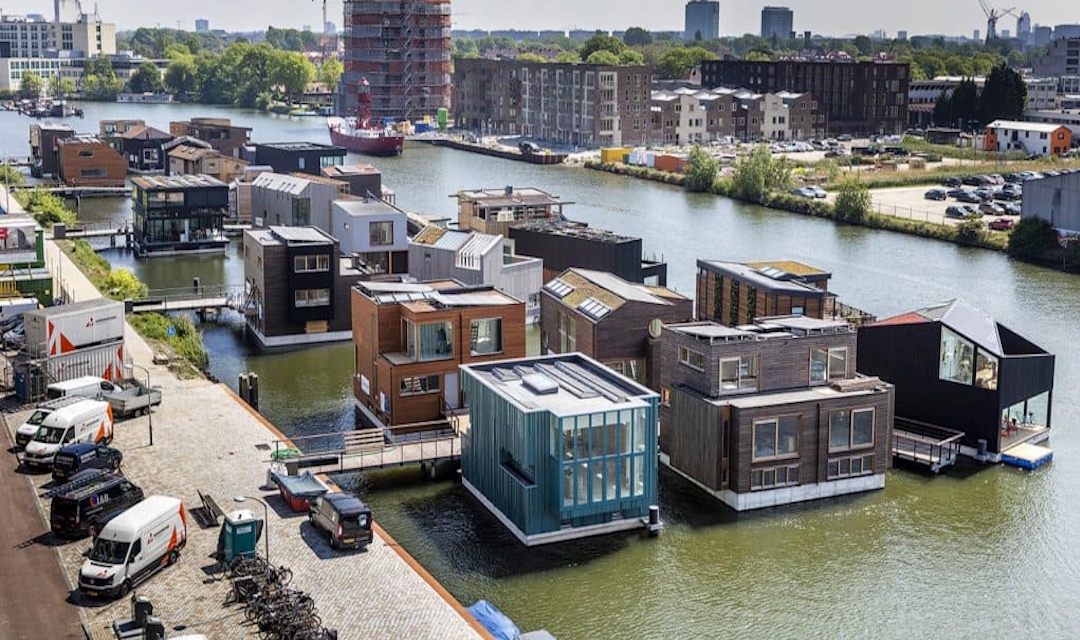
Amsterdam is known for its canals, historic bridges, and centuries-old architecture—but just north of the city lies Schoonschip, a floating neighborhood that redefines urban living. This community of 46 floating homes is a bold experiment in sustainable, resilient, and technologically advanced water-based housing. It combines innovation, environmental responsibility, and social cohesion, demonstrating how cities can adapt to climate change and urban density.
A Community Built from Vision
Schoonschip is more than a collection of homes—it’s a community designed by its residents. Planning began over a decade ago when a group of forward-thinking citizens envisioned a sustainable neighborhood on water. Unlike typical developments, residents were actively involved in decisions about platform dimensions, utilities, solar energy systems, and public spaces. One story often told in the community is about a resident who convinced the developers to raise the platforms an extra 40 centimeters to anticipate extreme flood events, a decision that proved prescient during a heavy storm in 2022.
Floating Platforms: The Engineering Backbone
Every Schoonschip home rests on a reinforced concrete and steel platform, designed to float while supporting the full weight of the house and its occupants. Platforms are often 15–25 meters long and 6–10 meters wide, with thicknesses of 40–60 centimeters depending on load calculations. Hollow compartments filled with air act as buoyancy tanks, ensuring homes remain stable even if one compartment fails.
The steel reinforcement provides flexibility, while concrete offers durability against corrosion and water exposure. Each platform is individually anchored to the canal bed with tensioned cables attached to piles, allowing vertical movement with tides and seasonal water fluctuations while preventing horizontal drift.
Modular Construction and Prefabrication
Schoonschip homes are modular, with large sections prefabricated off-site. These modules are floated into place and assembled on the platforms. Prefabrication reduces construction time, lowers environmental impact, and allows precise engineering tolerances. Homes range from 70 to 200 square meters, with multi-story designs, rooftop terraces, and flexible interiors. Many units include movable walls and modular furniture to adapt living spaces to changing needs.
Buoyancy and Stability Calculations
Engineers calculate load-bearing capacity meticulously. A typical Schoonschip platform supports 60–100 tons, accounting for structural weight, furniture, residents, water tanks, and rooftop installations like gardens or solar panels. Ballast systems are sometimes added to lower the center of gravity, enhancing stability during storms or high winds. Tilt sensors and monitoring systems alert residents if unusual movement occurs, though real-world incidents are rare due to precise engineering.
Utilities Integration: Energy, Water, and Waste
Schoonschip is designed as an energy-neutral community:
Electricity: Solar panels on every home feed a shared microgrid, supplemented by battery storage.
Water: Rainwater is collected and filtered for non-potable use. Greywater is treated locally and reused for toilets and irrigation.
Waste: Composting toilets reduce sewage output, while organic waste is processed in communal facilities.
Internet and electricity: Flexible cabling systems connect homes to the grid, accommodating vertical movement without risk of disconnection.
This integrated approach reduces reliance on city infrastructure and allows homes to operate independently if needed.
Environmental and Climate Resilience
One of the most innovative aspects of Schoonschip is its resilience to climate change. The floating platforms allow homes to rise and fall with water levels, protecting residents from floods. The neighborhood is engineered to survive storms, strong currents, and ice formation. Green roofs and gardens absorb rainwater and reduce heat, while the canals themselves act as natural buffers, supporting biodiversity and enhancing ecological stability.
Social and Community Stories
Schoonschip fosters a tight-knit community culture. Residents often gather on communal docks for events, workshops, or gardening sessions. One resident started a shared boat library, where electric boats are available for communal use, reducing individual car dependency. Another story involves the creation of a floating music platform, where community concerts and celebrations are held directly on the water—a unique way to connect neighbors in a shared, sustainable environment.
Comparison to Traditional Canal Houses
While Amsterdam’s historic canal houses are famous for their narrow, vertical design and wooden pile foundations, Schoonschip homes offer greater width, modular flexibility, and energy efficiency. Where canal houses struggle with subsidence, maintenance, and energy inefficiency, floating homes are engineered for stability, sustainability, and modern living standards. Rooftop terraces, solar panels, and green spaces further differentiate floating homes from traditional structures.
Technical Innovations and Monitoring
Schoonschip integrates advanced monitoring and smart-home technologies. Sensors track water levels, structural tilt, and energy usage. Residents can monitor electricity production, water use, and waste processing through a central dashboard. The community also experiments with innovative materials, such as lightweight insulation panels and recycled composite construction, which reduce platform weight without compromising strength.
Why the Dutch Embrace Floating Homes
The Netherlands has a long and intimate relationship with water. Around one-third of the country lies below sea level, and the Dutch have spent centuries building dikes, canals, and pumping systems to manage floods and reclaim land. In a country where water is both a threat and a resource, floating homes are a logical evolution of Dutch ingenuity.
Floating homes allow the Dutch to expand urban housing without encroaching on valuable land. Cities like Amsterdam are densely populated, and traditional housing options are limited. Floating neighborhoods provide additional space while making use of canals, rivers, and harbors—areas already integrated into the urban landscape.
They also serve as a solution to climate change, resilient to rising sea levels and floods. Dutch culture values innovation, sustainability, and design excellence, all reflected in floating home communities like Schoonschip. Finally, the water-centric lifestyle encourages outdoor activity, community interaction, and a deeper connection with nature.










Related Posts


Stay Informed With the Latest & Most Important News
Previous Post
Next Post












Advertisement