

Now Reading: Whistled Languages: The Ancient Art of Talking Through Whistles
-
01
Whistled Languages: The Ancient Art of Talking Through Whistles


Long before the age of telephones, radios, or the internet, humans found ingenious ways to communicate across long distances. One of the most fascinating of these methods is the whistled language—a system in which spoken language is transformed into melodic whistles that can travel across valleys, mountains, and dense forests. Unlike spoken or written words, whistled languages were designed purely for efficiency, allowing people to send messages across challenging terrain where normal speech would fail.
Unlike conventional languages, whistled languages rely on pitch, rhythm, and intonation rather than consonants and vowels, making them ideal for outdoor environments where normal speech cannot travel far.
What’s Up With Whistled Languages?
At first glance, whistled languages might seem like a secret code or a whimsical invention of rural communities. In reality, they are fully functional languages, capable of conveying complex ideas, warnings, and even humor.
The principle behind these languages is surprisingly simple yet remarkably effective: speech is reduced to its melodic essence. This means that words and sentences are stripped down to pitch, tone, and rhythm, which can travel long distances. In practical terms, a whistle can carry much farther than a voice, especially in open spaces, valleys, or mountainous regions. Some whistled languages are even intelligible over distances of three to five kilometers (about two to three miles), making them ideal for farming, herding, or community coordination.
Whistled languages also have cultural significance. They are intertwined with daily life, traditional songs, and local stories. In many communities, children grow up learning the whistled form alongside the spoken language, ensuring continuity from generation to generation.
A Brief History
The origins of whistled languages are difficult to trace precisely, but historical records and anthropological studies suggest they have been used for thousands of years. Wherever human settlements faced geographical obstacles—dense forests, deep valleys, or rugged mountains—people invented ways to make their voices carry farther.
In Mesoamerica, pre-Columbian civilizations appear to have used whistled tones to communicate over hills and fields. On the Greek islands, shepherds developed whistled systems to signal each other while tending their flocks. In Turkey, whistled “bird language” has been documented for centuries as a vital part of rural life. Unlike writing, which emerged largely for record-keeping, whistled languages were born purely out of necessity and practicality.
Definition and Mechanism
A whistled language is a phonetic adaptation of a spoken language. Consonants, vowels, and tones are simplified into high and low pitches, rhythmic patterns, and modulated tones, enabling communication that is intelligible over long distances.
-
Vowels: Represented by specific pitch levels.
-
Syllables: Whistle duration matches spoken syllable length.
-
Consonants: Often omitted or reduced, inferred from context and syllable rhythm.
-
Intonation: Rising and falling pitches convey questions, emphasis, and emotional nuance.
How Whistled Languages Work
The mechanics of whistled languages are fascinating. Essentially, they simplify spoken language while preserving its meaning.
Vowels and tone carry most of the information: In tonal languages like Chinantec in Mexico, the pitch of the whistle corresponds directly to the spoken word’s tone. A high whistle might indicate one word, while a low whistle indicates another.
Consonants are often reduced or represented by pitch changes: In non-tonal languages, like Silbo Gomero in Spain, consonants may be replaced with brief rises, falls, or breaks in the whistle, allowing listeners to reconstruct words from patterns of sound.
Rhythm and context matter: Listeners often rely on the timing of whistles and contextual knowledge to interpret meaning correctly. A single whistle might signify “come here,” but a series of whistles in a specific rhythm could describe an entire event or warning.
This combination of pitch, rhythm, and context allows whistled languages to convey surprisingly complex information, from casual conversation to urgent messages about danger or weather.
Characteristics of Whistled Languages
Whistled languages share some common features across cultures:
Long-distance efficiency: Whistles travel farther than spoken words, especially in open spaces or across valleys.
Simplification of phonetics: Speech is reduced to its melodic core, with vowels and tone patterns carrying the main semantic load.
Integration with daily life: In many communities, whistled language is not just a tool—it’s a cultural practice tied to farming, herding, and social interaction.
Oral tradition and learning: Whistled languages are passed down naturally, often learned by children as a first or second form of communication alongside spoken language.
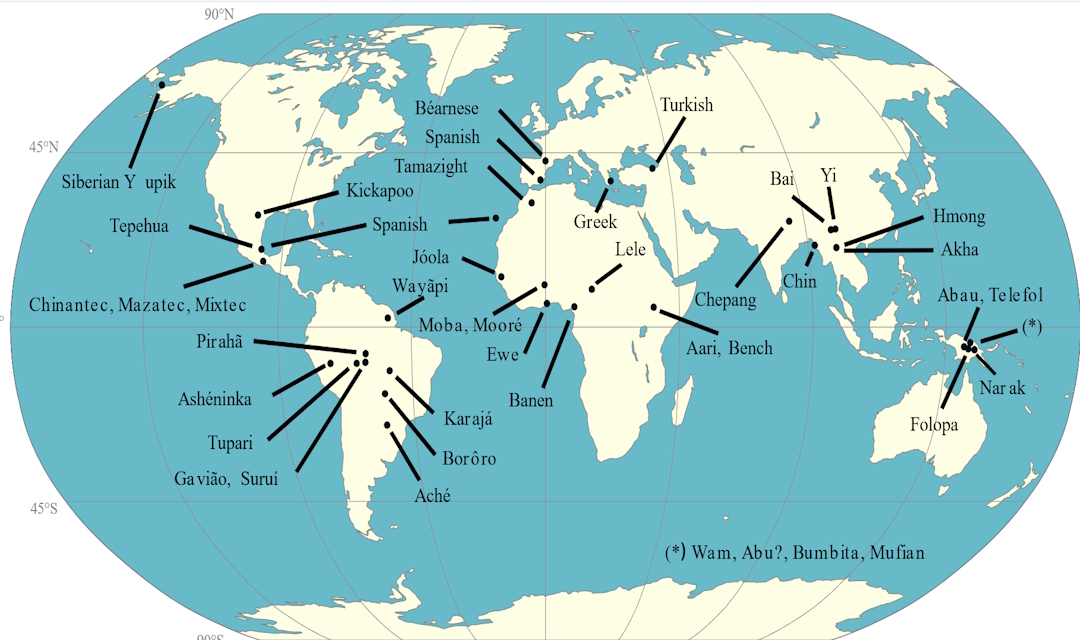
Global distribution of whistled languages. Photo: https://en.wikipedia.org/wiki/Whistled_language
Whistled Languages: Famous Examples Around the World
Kuşköy’s Bird Language (Turkey)
In the remote village of Kuşköy, in northern Turkey, villagers have been using bird language for centuries. Nestled among steep hills and valleys, communication through normal speech is often impossible. Farmers use this whistled system to coordinate work, announce visitors, or even spread gossip.
The Kuşköy Bird Language is remarkably sophisticated. Villagers can convey long, nuanced messages with a combination of pitch changes, whistle lengths, and rhythmic patterns. Children grow up learning both Turkish and the whistled form simultaneously, highlighting the natural integration of this unique language into daily life. Modern technology and urbanization have threatened its use, but efforts by local schools and cultural organizations are helping preserve it.
Antia’s Sfyria (Greece)
On the Greek island of Antia, shepherds have historically relied on Sfyria, a whistled form of Greek, to communicate across mountainous terrain. Using high-pitched, melodious whistles, shepherds could signal each other about the location of flocks, approaching visitors, or even exchange jokes.
Though less widely used today, Sfyria remains a cultural treasure. It is a vivid example of how environmental challenges inspire unique linguistic innovations. Local festivals occasionally feature demonstrations of Sfyria, keeping the tradition alive for tourists and younger generations.
San Pedro Sochiapam’s Chinantec (Mexico)
In San Pedro Sochiapam, Oaxaca, Mexico, the indigenous Chinantec people use a tonal whistled language based on their spoken Chinantec language. Unlike non-tonal whistled languages, where rhythm carries meaning, Chinantec whistles rely heavily on pitch to preserve the meaning of words.
This whistled language allows villagers to communicate across deep valleys while farming or herding animals. A single high-pitched whistle can indicate a specific object, while a series of tones might relay a complex message about location, danger, or tasks. Tonal whistled languages like this one demonstrate the incredible adaptability of human speech systems to environmental constraints.
La Gomera’s Silbo (Spain)
Perhaps the most famous whistled language is Silbo Gomero, from the Canary Island of La Gomera, Spain. Silbo mirrors Spanish in a whistled form, translating vowels and consonants into specific pitches and sequences. Shepherds historically used it to navigate the island’s deep ravines, rugged cliffs, and steep valleys, communicating messages that would have been impossible to hear otherwise.
Silbo Gomero is remarkable not just for its functionality but for its preservation. Recognized by UNESCO as an Intangible Cultural Heritage, it is taught in schools to ensure that future generations continue to speak and whistle it. Visitors to La Gomera can hear locals effortlessly “talking” through whistled melodies that carry for kilometers, a living echo of the island’s history.
Why Whistled Languages Matter Today
Whistled languages are more than quaint curiosities—they are living examples of human ingenuity, demonstrating how people adapt their communication to meet environmental challenges. They preserve linguistic diversity, cultural heritage, and the ingenuity of communities long before modern technology existed.
However, many whistled languages are endangered. Urbanization, modern communication tools, and population shifts have reduced their practical use. Preservation efforts—from educational programs to cultural events—are vital to keep these incredible systems alive. Studying them not only allows us to appreciate linguistic creativity but also teaches us about resilience, innovation, and the deep connections between humans and the landscapes they inhabit.
Fun Facts and Stories
-
Some whistlers can convey complex sentences, questions, and emotional nuance entirely through pitch and rhythm.
-
Shepherds in Turkey reportedly warned entire valleys of wolves using whistles.
-
On La Gomera, fishermen used Silbo to coordinate nets and boats without leaving the water.
-
Whistled language can be playful: children in remote areas often invent new melodies for messages, blending learning with music.
-
Whistled phrases can sometimes travel further than a shouting human voice, especially in valleys or across water.










Related Posts


Stay Informed With the Latest & Most Important News
Previous Post
Next Post












Advertisement