
Now Reading: Building Beyond the Limit: The Ultimate Story of Jeddah Tower
-
01
Building Beyond the Limit: The Ultimate Story of Jeddah Tower

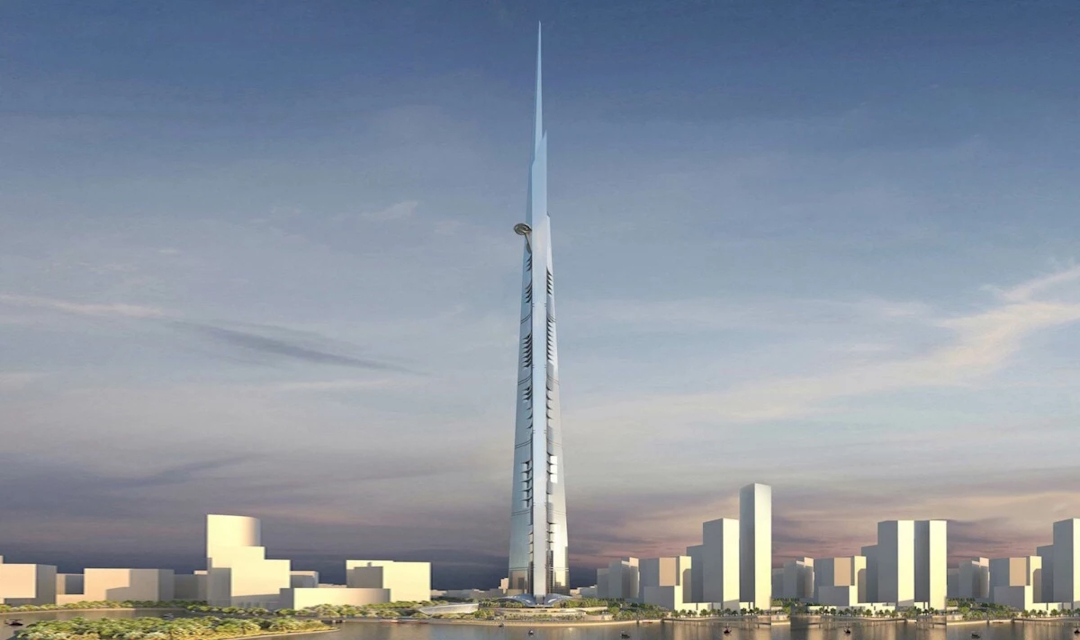
For centuries, humanity has harbored an obsession with reaching upward. From the mythical Tower of Babel to the soaring spires of New York, Chicago, and Dubai, our architectural history is defined by a relentless vertical march.
Yet, even in an era of supertall skyscrapers, one project stands alone as the ultimate test of human ingenuity: Jeddah Tower.
Located in the coastal desert of Jeddah, Saudi Arabia, this monument of modern engineering is designed to do what was once deemed physically impossible—become the world’s first 1-kilometer-tall building (engineered to reach at least 1,008 meters / 3,307 feet).
This is the definitive, inside story of a project that defied bankruptcy, political storms, and the very laws of physics to claim its place in the clouds.
The Blueprint of a Giant
When the Jeddah Economic Company (JEC) set out to build a tower that would dwarf Dubai’s Burj Khalifa (828 meters) by nearly 180 meters, they turned to the man who built it: American architect Adrian Smith.
To build a kilometer into the sky, Smith couldn’t just scale up existing blueprints. At that altitude, gravity is only half the battle; the true boss fight is the wind.
The Aerodynamic “Y” Footprint
At 1,000 meters, wind forces can generate immense, rhythmic lateral pressures that can make a building sway violently enough to cause structural failure—or at least severe motion sickness for those inside.
Inspired by the organic, folded leaves of a young desert plant, Smith designed a three-sided “Y” footprint.
-
Vortex Disruption: Each of the tower’s three wings tapers and terminates at different heights. This structural asymmetry “confuses” the wind, breaking up the air currents and preventing the formation of synchronized low-pressure vortexes (vortex shedding) that would otherwise push the building from side to side.
-
A Continuous Shear Wall: Unlike traditional skyscrapers that rely on massive perimeter columns, Jeddah Tower utilizes a structural system made entirely of interlocking, high-strength reinforced concrete shear walls. These solid internal walls handle both gravity loads and wind sheer simultaneously, leaving the interior incredibly open and column-free.
Defying the Soil and the Sea
Before soaring into the atmosphere, the tower had to be anchored into some of the most challenging terrain on earth. The construction site sits right on the edge of the Red Sea, where the soil is porous, sandy, and heavily saturated with corrosive saltwater.
To support a dead weight of approximately 900,000 metric tons, engineers executed a subterranean masterclass:
-
The Underground Forest: Workers drilled and cast 270 massive concrete piles, each 1.8 meters in diameter, driving them up to 105 meters (344 feet) deep—the vertical equivalent of a 30-story building buried underground—to anchor the structure into solid bedrock.
-
The Giant Raft: Atop these piles, crews poured a colossal, solid reinforced concrete foundation raft 5 meters (16 feet) thick to distribute the tower’s weight evenly.
-
Electrified Armor: To prevent the highly saline coastal groundwater from corroding the steel rebar within the concrete, engineers installed a cathodic protection system. By passing a continuous, low-voltage electrical current through the steel, they electrochemically halt the rusting process, ensuring the foundation remains sound for centuries.
The Silence in the Desert
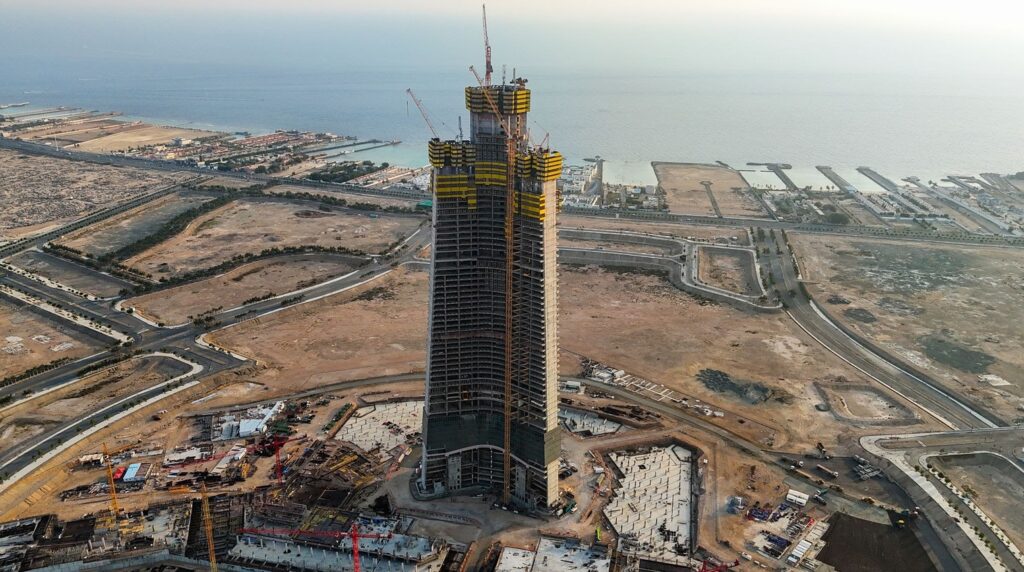
By late 2017, the tower was rising rapidly, its central concrete core poking through the coastal haze. But in January 2018, with the tower standing at 252 meters (827 feet) and 63 floors completed, the cranes suddenly stopped turning.
A massive anti-corruption sweep in Saudi Arabia led to the arrest and asset freezing of key figures behind the project, including Prince Al-Waleed bin Talal and the executives of the primary contractor, the Saudi Binladin Group.
With its funding streams severed, the skeleton of the world’s tallest building sat frozen in the desert. For over five years, critics mocked the concrete monolith as a “ghost tower” and a monument to overambitious folly.
The Great Resurrection
Against all odds, the narrative shifted. In late 2023, the Jeddah Economic Company launched a massive global bid to resume construction, confirming that the existing concrete core had been thoroughly inspected and remained in pristine structural condition.
In a historic move, JEC signed a $1.9 billion contract to bring the Saudi Binladin Group back to the site.
Work officially resumed at full capacity, and the site transformed into a hyper-efficient mega-operation:
-
5,200+ workers are active on-site around the clock.
-
The tower is climbing at a breakneck cycle of one new floor poured every 4 to 5 days.
-
The concrete core has successfully passed the 105th floor (crossing 400 meters in height), putting it well over the halfway mark of its ultimate vertical journey.
Pushing Physics to the Absolute Limit
Building a kilometer high means solving problems that don’t exist anywhere else in construction.
Liquid Stone: Pumping Concrete Into the Clouds
How do you push wet, heavy concrete nearly a kilometer straight up without it hardening inside the pipes?
-
The Ice-Concrete Mix: Daytime temperatures in Jeddah routinely exceed 40°C (104°F). To prevent the concrete from setting prematurely, it is mixed exclusively at night, and a significant portion of the water is replaced with crushed ice to keep the mixture cool and slow-acting.
-
Super-High-Pressure Pumps: Highly specialized, ultra-high-pressure pumps force this cold, slow-curing concrete through heavy-duty steel pipes at pressures that would rupture standard lines.
-
A Steel Crown: Because concrete becomes too heavy to support itself at extreme heights, the top third of the tower will transition to a lighter, pre-fabricated structural steel frame.
Vertical Transit at Highway Speeds
In a kilometer-tall building, traditional steel elevator cables become a hazard. A steel cable longer than 500 meters is so heavy that it will snap under its own weight, even without a cabin attached.
To solve this, Jeddah Tower’s express elevators utilize carbon fiber ropes (such as KONE’s UltraRope). Carbon fiber possesses incredible tensile strength, weighs a fraction of steel, and drastically reduces the energy needed to move the cabins.
The tower will feature 59 elevators, including double-decker express cabins traveling at 10 meters per second (36 km/h or 22.4 mph). Because ascending 600+ meters that quickly causes rapid shifts in atmospheric pressure, the cabins are fully sealed and pressurized, slowly adjusting the internal climate to prevent vertigo and painful ear-popping.
The Crown Jewel: The Hanging Sky Terrace
Perhaps the most breathtaking feature of the Jeddah Tower will be cantilevered outdoor balcony on the 157th floor (roughly 638 meters above the ground).
Originally, the blueprints intended for this massive, 30-meter-wide circular platform to serve as a helipad. However, aviation testing revealed that high-altitude thermal updrafts and unpredictable wind shear rushing up the face of the glass facade made helicopter landings far too dangerous.
Rather than scrapping the structure, the architects converted it into the Sky Terrace—the world’s highest outdoor observation deck, offering visitors a heart-stopping, open-air view of the Red Sea and the horizon beyond.
That seemingly simple sentence actually hides one of the most incredible and challenging pieces of the entire project.
Here are the fascinating, deeper details about what life and engineering will look like on the 157th floor:
1. How Do You “Hang” a 30-Meter-Wide Platform?
Building a balcony on an ordinary house is simple, but constructing a massive circular platform with a diameter of 30 meters (98 feet) that literally juts out into the open air at an altitude of over 630 meters (2,067 feet) is an engineering nightmare.
-
The Cantilever Structure: The platform has absolutely no external support columns holding it up from below. Instead, it is anchored entirely inside the tower’s massive, reinforced concrete core using heavy, high-tension steel beams that penetrate deep into the building’s spine to counteract the leverage effect.
-
Aerodynamic Underbelly: The underside of the platform is sculpted with a smooth, aerodynamic profile. This allows the high-velocity wind rushing up the facade of the tower to glide smoothly around it, rather than pushing it upward or inducing dangerous, structural vibrations.
2. Microclimate Conditions on the 157th Floor
Visitors stepping onto the Sky Terrace will experience a completely different climate compared to the base of the tower in Jeddah:
-
The Temperature Drop: At this altitude, the air temperature is, on average, 5°C to 8°C (9°F to 14°F) cooler than at ground level. When Jeddah’s summer heat hits an unbearable 42°C (108°F) at the base, it will be a much more pleasant 34°C (93°F) on the terrace.
-
Winds and Glass Barricades: Because high-altitude winds are fierce and relentless, the platform will be wrapped in heavy-duty, high-strength structural glass barricades. These invisible shields will protect visitors from violent drafts while preserving a seamless, 360-degree panoramic view.
-
Walking on Air: To maximize the thrill, portions of the terrace floor are designed to feature multi-layered, ultra-toughened structural glass. Brave visitors will literally be able to look straight through their feet into a 638-meter drop.
A View Across the Horizon
Due to the curvature of the Earth, the theoretical line of sight from this height extends over 90 kilometers (56 miles). On clear desert days, visitors on the Sky Terrace will be able to see the mountain ranges deep within the Saudi Arabian interior on one side, and the endless blue of the Red Sea stretching toward the African coast on the other.










Related Posts
Stay Informed With the Latest & Most Important News
Previous Post
Next Post


Advertisement